


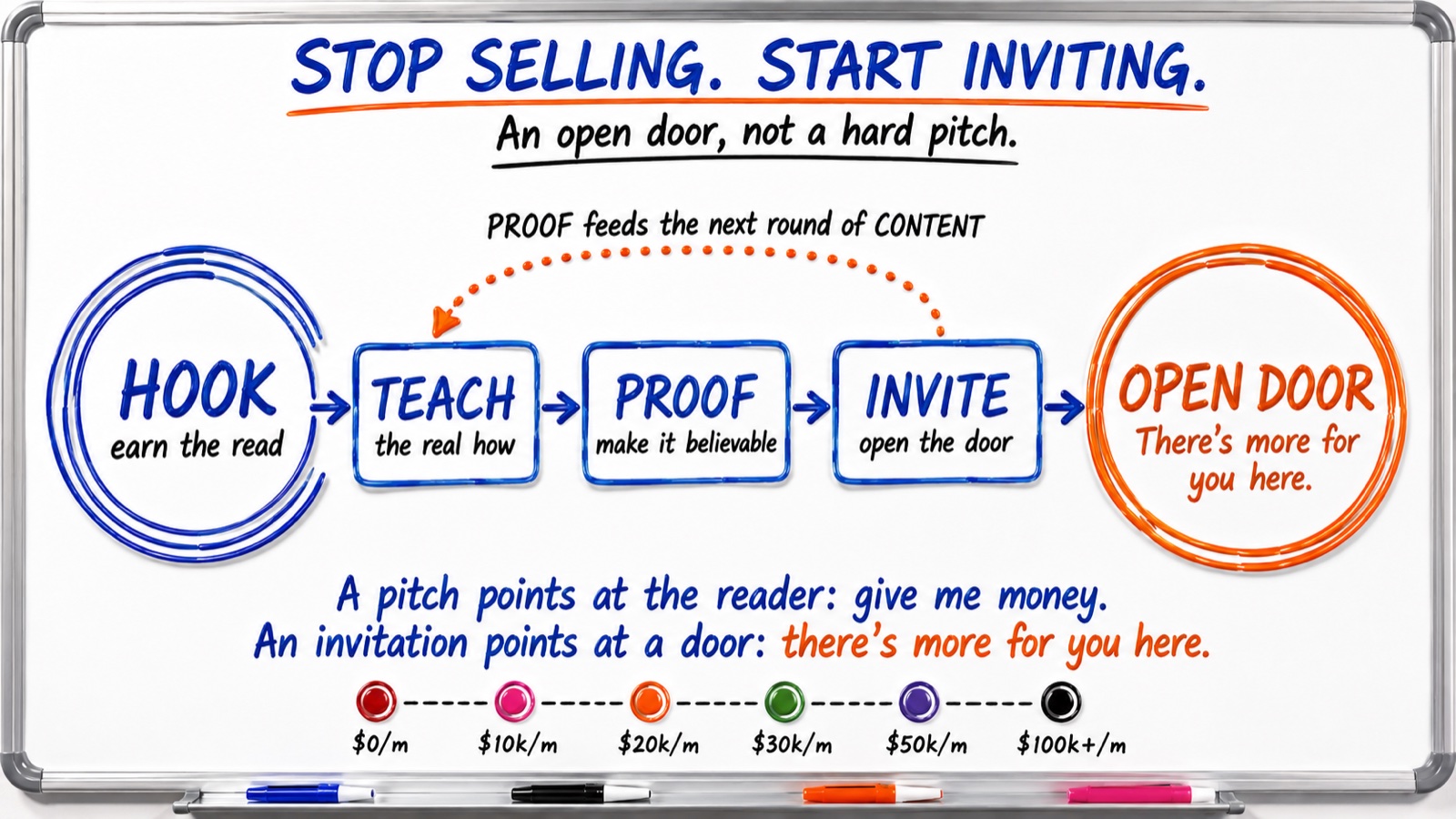
#NFF · Stop Selling. Start Inviting.
Your content is good — useful, generous, clear — and it still makes you £0. The thing it's missing isn't a harder pitch. It's an open door.
One Saturday morning. One Claude Skill. The rest of the week off the clock — and the carousels and singles still landing on schedule. This isn't a hack. It's just where I should have started.

I sat down on a Sunday evening about six months ago and did the maths I’d been avoiding for a year.
16 hours a week on content. Sometimes 18. The carousels. The singles. The two newsletters. The captions. The repurposing. The thumbnails. The “let me just tweak that hook one more time” loop.
That’s two full working days a week. Eight working days a month. Ninety-six working days a year producing content for a business that wasn’t growing in proportion to the effort going in.
The worst part wasn’t the hours. The worst part was that I’d become bored of my own content. Five carousels a week, same shape, same hook structure, same Saturday morning panic about the Wednesday slot. Some weeks I couldn’t remember whether I’d actually posted Wednesday’s piece or just thought about posting it.
That’s phantom load at its purest. Effort going in. No outcome that matched it. The work was real, the cadence was real, the bank account didn’t move.
The fix wasn’t more discipline. The fix was admitting I’d been doing it the slow way for 18 months.
Today my content week looks like this:
Total weekly content time: ~3.5-4 hours. Down from 16. The output volume held. The output quality lifted because the Skill enforces an 8/10 self-score on every piece — which I never enforced on myself when I was running it manually.
The bit that really matters: I haven’t dropped a posting day in 6 months. The cadence holds because the friction is gone.
The trap is the same for almost everyone I work with. Three patterns repeat:
Pattern 1 — you treat content as creation, not curation.
Most creators sit down at a blank document and try to invent something to say. That’s the slowest possible mode. Claude can draft any piece of content in 90 seconds if you’ve fed it the right context. Your time should go into the 30% that only you can do — the specific story, the in-the-trenches detail, the voice that makes it sound like you instead of a bot. Curating and codifying beats creating, every single time.
Pattern 2 — you don’t have a Skill, you have a habit.
Every time you sit down to write a carousel, you start from zero. You re-explain your business to ChatGPT. You re-paste your audience. You re-describe your tone. By the time the actual work starts, you’ve already burnt 20 minutes on context-establishment. A Skill bakes the context in once. You say a code word — “Carousels are a go” — and Claude already knows the audience, the offers, the voice, the pillars, the brand colours, the formats. You’re starting at minute 10, not minute 0.
Pattern 3 — you optimise the wrong block of the week.
Most creators try to spread content production across the week — a little Monday, a little Wednesday, a little Friday morning panic. That maximises the cognitive cost. Every context switch back into “creative mode” burns 15-20 minutes of warm-up. Batching the entire week into one 90-minute Saturday block kills the switching cost stone dead. You sit down once. You leave the laptop once. The week is done.
This is compound mode for content production. Build the Skill, batch the work, leave the rest of the week alone.
This is the part most “content batching” articles skip — what the 90 minutes literally looks like:
That’s it. Saturday’s done. The week’s content is built.
Every batched-content system eventually drifts back into chaos. The rule that prevents it: never start the Saturday block without last week’s signal banked.
If I haven’t captured client conversations, decisions made, problems solved, observations from the week — the Skill has nothing to mine. The output gets generic. The Saturday block stretches to 3 hours because I’m trying to invent material instead of curating from real signal.
So I capture every week, even when the week feels boring. Three notes a day. Voice memos in the car. Two lines in Notion after a call. By Saturday morning there are 15-20 raw fragments to feed the Skill. The system holds because the input keeps showing up.
The Skill is the engine. The signal is the fuel. Run the engine on empty and you get noise.
Use case: Generate next week's content in 60 minutes flat. Tool: Claude Prompt: "Act as my content strategist. I'm building [your one-line positioning]. Audience: [who]. Voice markers: [3-5 phrases that sound like you]. Banned words: [3-5 that don't]. Generate 5 carousel concepts + 3 single-post concepts for next week. Each piece must: (1) lead with a Promise×Payoff hook in slide 1 / line 1, (2) teach AND sell — never one without the other, (3) use Old/New positioning where natural, (4) end with a code-word CTA. Score each piece out of 10. Bin below 8. Output the 8+ pieces only, in shipping order." Output: 8+ scored content pieces, ready to drop into Canva.
Three months in, here’s what I track:
The last one is the metric that matters. Followers are vanity. DMs with a code word are intent. The Skill’s CTAs route every piece toward a specific code-word reply that lands in a ManyChat sequence — and the qualified prospects book a call from there without me being in the conversation.
That’s build the backend applied to the content engine. The Skill produces. Buffer schedules. ManyChat qualifies. I show up at the qualified-call stage.
If you’re running 16+ hours a week on content, you’re probably not lacking discipline. You’re lacking a Skill.
Three moves to install before next Saturday:
You don’t need a bigger team. You don’t need a smarter AI. You need a Skill, a block, and the rule that keeps the input flowing.
Build the backend of your content engine. Then take Saturday afternoon back.
— Quinton
📬 No-Fluff Friday — one sharp move every Friday morning Dubai.
Read the archive: newsletter.founders.systems
.







Member discussion