


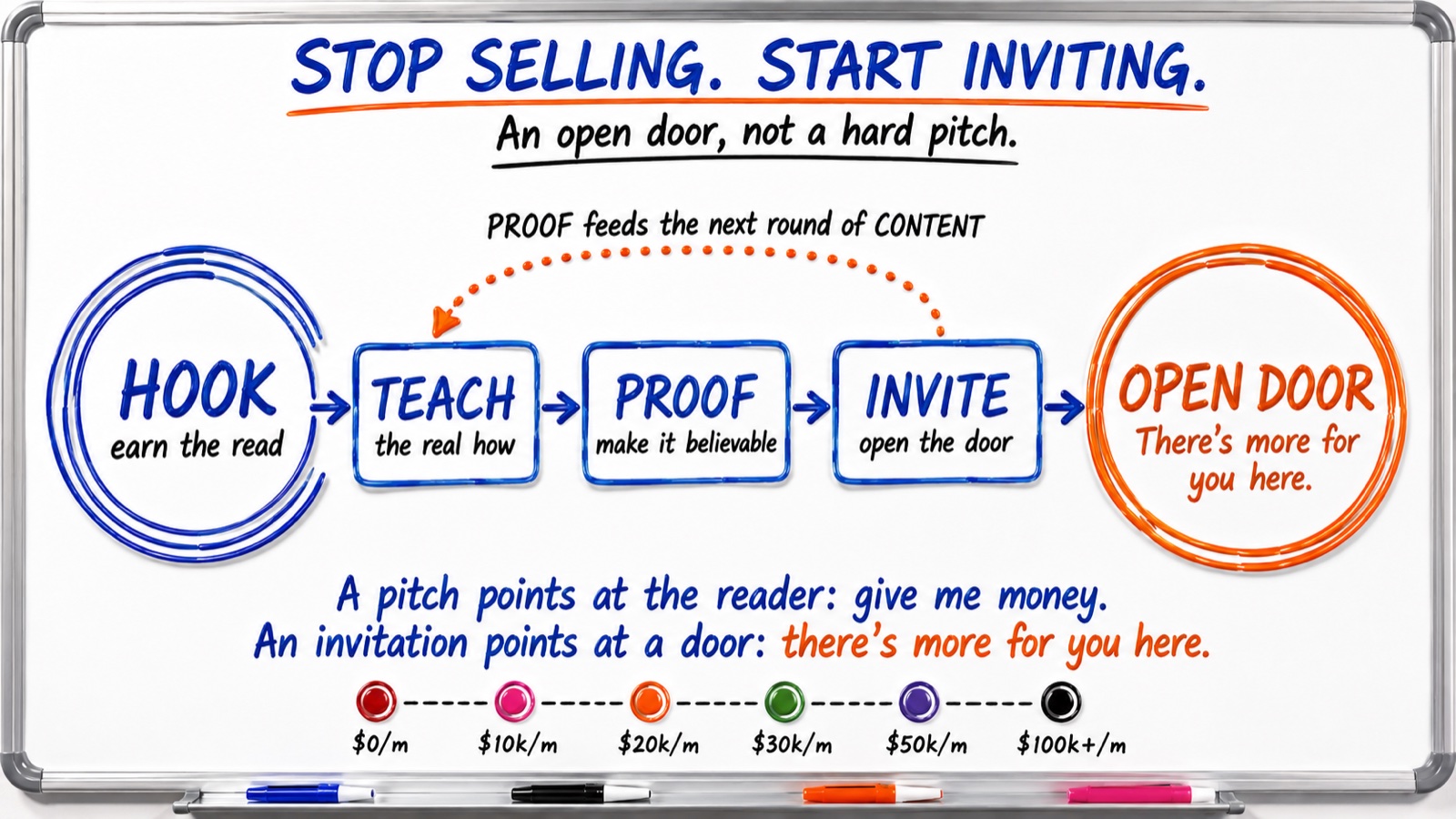
#NFF · Stop Selling. Start Inviting.
Your content is good — useful, generous, clear — and it still makes you £0. The thing it's missing isn't a harder pitch. It's an open door.
It was never effort — it's order. Most creators, solopreneurs and coaches build Content → Brand → Backend, then quietly stall in the same $6k band for a year. The 2026 winners build the exact inverse: same engines, same hours, a completely different ceiling.

I've had the same conversation about forty times in the last six months. Different faces, same script. A coach sat across the table from me — or, let's be honest, a slightly frozen Zoom rectangle — telling me they're stuck somewhere between $18k and $30k a month. Six figures next quarter, they reckon. It's always next quarter. Next quarter is where ambition goes to live rent-free.
And they've genuinely tried everything. More posts. Better hooks. Raised prices, then lost their nerve and dropped them again. Hired a VA, fired the VA, hired a different VA. Launched a low-ticket. Launched a high-ticket. Went "all-in on LinkedIn", then "all-in on Reels", then crawled back to "doubling down on YouTube" with the haunted look of someone who's reorganised their whole life around an algorithm three times in one year. And the revenue line? It doesn't move. Not really. It wobbles around in a $6k band, month after month, and they're convinced the problem is that they're not working hard enough.
It isn't effort. It's almost never effort. People at this level are working plenty hard — that's rather the issue. It's sequence.
Most creators and coaches build the business in the wrong order. Content first, Brand second, Backend dead last — usually because the backend is the one part nobody on your timeline is making reels about. There's no dopamine in a working tagging rule. The result is a ceiling that the under-built backend simply can't carry. The brand layer looks lovely. The content's consistent. And the backend is held together with three Zaps, two tools you stopped paying for, and a Google Doc optimistically titled "ideas".
That gap is the lag. That lag is the $30k ceiling. And it's a sequencing problem, not a hustle one — which is annoying, because hustle is the thing you actually know how to do.
Founder lag is the gap between what your front-end promises and what your backend can actually carry. The brand promises a transformation. The content drives the demand. And then the new subscriber lands on a nurture sequence that doesn't exist, the lead magnet emails them twice and then ghosts them like a bad first date, the application form drops into a Google Sheet nobody's opened since Tuesday, and the new buyer gets a Stripe receipt followed by… silence. Lovely. Very premium.
The leads aren't the problem. The leak is the problem. And here's the cruel maths of it: every extra piece of content you ship makes the leak worse, because you're now pouring more water into a bucket you never bothered to check for holes.
This is the bit most people miss entirely. More demand into an under-built backend doesn't create growth — it creates chaos. And chaos has a very specific smell: missed DMs, follow-ups three days too late, the customer you accidentally charged twice, manual onboarding at 9pm on a Sunday, and that slow creeping dread where you realise part of you doesn't actually want the next sale, because the next sale is the one that breaks something.
That feeling — that flinch at your own success — is the ceiling. It isn't out there in the market. It's in your wiring.
Every business — yours, mine, the coach two doors down with the suspiciously good ring light — runs on three engines:
You can't skip any of them. All three have to exist. But you can absolutely run them in the wrong order — and almost everyone does, because the wrong order is the one that feels good.
The common sequence — the one that smacks into the $30k ceiling like clockwork — goes:
The 2026 winners ship the exact inverse:
Same three engines. Inverted order. Completely different ceiling. It's almost crazy how simple it is.
Here's the genuinely cruel part: ship-content-first feels like progress. You can see it. Likes, comments, the follower count ticking up, the little hit of validation on a Tuesday afternoon when you should be doing literally anything else. Backend-first feels like nothing for the first thirty days. No applause. No vanity metric. Just a Zap quietly firing every time someone joins the list, and a tag sorting the buyers from the browsers while you sit there wondering if it's even working.
This is exactly why most people never make the switch. The early signal rewards the wrong sequence. Posting feels productive. It is, in fact, cardio. And by the time the ceiling becomes blindingly obvious, you've stacked eighteen months of audience on top of a backend that was never designed to monetise a fraction of it. The brand is the freshly waxed bonnet. The backend is the engine block that isn't there.
So someone tells you to "post more." And you do. And the ceiling — predictably, infuriatingly — holds.
Five minutes. Pen and paper, not a fancy Notion template — the template is procrastination wearing a productivity costume. Honest answers only.
Score a clean five and you're not the audience for this article. Score two or fewer — which most people do — and you've just found the lag. It was never your hooks. It was your sequence.
You can't vanish off-grid for six weeks. The content keeps the lights on. But you can throttle — there's a big difference between turning the tap off and turning it down.
You won't see this in week one. The point is week 12, week 24 — the quiet month where revenue holds even though you took a fortnight off. That's what a sequenced backend buys you. It isn't flashy. It's the thing that holds when you can't.
And this, by the way, is exactly what I mean when I say take back your time. Not "work less" — that's a poster, not a strategy. It's: work in the right order, so the work compounds without needing you in it every single hour.
Build the surface that catches the lead before you build the surface that creates it. That's it. That's the whole thing.
Capture before creation. Backend before content. Plumbing before promotion. Every time. No exceptions, no "but my niche is different" — your niche is not different, I've checked.
The $30k ceiling isn't a market problem. The market has more money sloshing around in it than you could spend in three lifetimes. It's a sequencing problem — and the fix isn't more effort, it's the slightly uncomfortable courage to drop your content volume for thirty days while you quietly fix the bit nobody's ever going to applaud.
Here's what nobody tells you about flipping the sequence properly. The first 30 days feel slow. The next 60 feel quiet. And then somewhere around day 90, something genuinely strange starts happening — and once you've felt it, you will never voluntarily run the old order again.
The first thing that changes is your relationship with the content treadmill. When the backend's wired properly, every post you ship has somewhere to go. A lead magnet that nurtures for nine days. A tag that splits buyers from browsers without you thinking about it. An offer that lands on day 14 like clockwork. The thing you posted on Tuesday is still quietly earning on Friday. You stop feeling the gnawing pressure to post every single day, because each post is now doing roughly five times the work it used to.
The second thing that changes is the size of the offer you'll actually charge for. When the backend can genuinely deliver, you stop pricing for "what feels comfortable" — which is always too low — and start pricing for what the transformation is honestly worth. The $2k offer becomes a $6k offer becomes a $20k offer. Not because you got cocky, but because the delivery surface can finally carry the promise.
The third thing — the one I didn't see coming — is what it does to your week. The Saturday batch holds. Sunday's stack hygiene catches the drift. Monday opens already wired. You stop feeling like the business needs you breathing into it every hour. That's compound mode. And that — not the motivational poster version — is what taking back your time actually looks like in practice.
That 5-minute Backend GPS diagnostic above is the same one I open every conversation with inside my community. If you scored two or fewer, the inside of Founders & Systems is where the rebuild actually happens — the frameworks, the locked vocabulary, the rebuild sequence, and a room full of creators, solopreneurs and coaches working through it right alongside you.
DM me "BACKEND" on LinkedIn or Instagram and I'll send it over — the Backend GPS one-pager · paste-ready · no opt-in wall · keep it or bin it, no hard feelings
Build the backend. Lock the brand. Spin the content engine — in that order.
Quinton · Founders & Systems
Helping creators, solopreneurs and coaches build a business that runs without them.
.







Member discussion