5 Ways to Use Claude When You're Building From Scratch.
Most startup founders are doing the work of five people. Claude won't change that overnight — but used the right way, it handles the five tasks that eat your week so you can focus on the one that actually builds the business.
When you're starting a business, you are the business.
You're the strategist, the marketer, the writer, the researcher, the customer service team, and the operations department — all before lunch.
That's not a productivity problem. That's just the reality of building from zero. And no tool in the world removes that reality entirely.
**But Claude — used the right way — does something genuinely useful. **
It handles the repetitive, time-consuming, brain-draining parts of those roles so you can spend your energy on the part that actually matters: building something people want.
Most founders use Claude for the occasional email or quick brain dump. That's fine. That's useful. But it barely scratches the surface.
💡
Here are five ways to use Claude that will actually move the needle when you're building from the ground up.
First: A Quick Reframe
Before we get into the five ways, let's deal with the common mistake.
Most people open Claude like they'd open Google. They type a question. They get an answer. They close the tab.
That's Claude as a search engine. It's the least powerful version of what it can do.
The better frame: Claude is your first hire.* * Not a robot that does everything. Not a magic button. A sharp, knowledgeable colleague who can work through complex problems with you, produce first drafts you can refine, research anything you ask, and never needs a lunch break.
When you start thinking about Claude that way, everything changes.
Way 1: Turn Your Thinking Into a Business Plan — Fast
The graveyard of startup ideas isn't full of bad ideas. It's full of ideas that never got out of someone's head because turning a vision into a concrete plan felt too hard, too time-consuming, and too intimidating.
Claude removes that excuse.
Describe your idea in plain language — who it's for, what problem it solves, roughly how you see it working — and Claude can help you build out a business model canvas, a market opportunity summary, competitive positioning, a lean 90-day launch plan, revenue model options, and a list of your top 10 assumptions to test first.
Research that previously took two to three hours compresses to under 20 minutes. And the output reflects your specific idea, not a template.
This isn't about letting AI think for you. It's about using Claude as a thinking partner that structures your ideas into something you can act on.
PROMPT TO TRY - Click 👇
👉 “Here’s my startup idea: [insert idea], Act as a business strategist.Break down the core business model (how this actually makes money)Identify the biggest assumptions that could kill this ideaTell me what I need to test in the next 30 daysMap out a lean 90-day execution plan to validate and grow it”Don't hold back, give me the truth, highlight any assumptions moving forward.
⚠️ Don’t overcomplicate it.
You’re not building a business yet — you’re testing if it deserves to exist. Because at some point…
“polishing the engine forever becomes procrastination wearing a tuxedo.”
💡 Use the prompt above. Helps you Test fast. Adjust faster.
*If you want the full breakdown (with real examples, frameworks, and execution templates), it’s inside Founders & Systems comunity. *
Competitive research is one of those tasks every founder knows they should do but almost nobody does properly. It takes too long. There are too many tabs. The findings disappear into a doc nobody reads.
Claude changes the economics of this completely.
Paste in a competitor's website copy, LinkedIn description, or pricing page and ask Claude to extract their key positioning claims, identify the audience they're targeting, summarise their offer structure, and find the gaps — what they're NOT saying, what audience they're not serving.
Then ask Claude to help you find the white space. The positioning angle nobody has claimed. The pain point everyone acknowledges but nobody solves properly.
What used to take two to three hours now takes 20 minutes and produces a cleaner, more actionable output.
PROMPT TO TRY - Click 👇
Here is Competitor A’s website copy: [paste].Here is Competitor B’s website copy: [paste].Act as a business strategist and market positioning expert.Analyse and compare their positioning, messaging, and value propositionsIdentify the specific audience segments each competitor is targetingHighlight overlaps, strengths, and weaknesses in their communicationIdentify clear gaps in the market — where no audience is being effectively addressedRecommend strategic positioning opportunities to differentiate and capture underserved segments
Way 3: Build Your Content Engine Without a Team****
If you're building a brand as part of your startup strategy — and you should be — content is non-negotiable. You need a newsletter, social posts, long-form content, email sequences. You need it consistently. You need it to sound like you.
That's a full-time job. Which is exactly why most solo founders either skip it or produce content in chaotic, exhausted bursts.
Claude is the engine underneath a consistent content operation.
You give Claude your brand voice, your audience, your core message, and your content format — once, either through a detailed prompt or a reusable Skill file.
From that point, producing content looks like this:
You bring a topic or rough angle
Claude produces a full first draft — newsletter, post, email, script
You spend 15–20 minutes editing and refining
You publish
Founders using this approach are cutting campaign production time by up to 75% while maintaining a consistent brand voice across every platform.
PROMPT TO TRY - Click 👇
Here is my brand voice: [describe].Here is my target audience: [describe].Topic: [insert topic].Act as a strategic content writer and newsletter editor.Write a complete newsletter issue that:Opens with a strong, attention-grabbing hookDelivers one clear, high-value insight (no fluff, no distractions)Maintains a direct, punchy tone aligned with the brand voiceUses clean structure for readability (short paragraphs, clear flow)Ends with a compelling and action-driven CTAEnsure the content is engaging, practical, and written in a human, conversational style that resonates with the target audience.
Subscribe as a Paid member to continue reading the article and get free indepth prompts and Claude Skills as part of your memebership.
The £0 AI Stack Running My Entire Business Backend.
You're using one AI tool for everything and getting 60% of the capability. Here's the £0 stack — Claude + ChatGPT + Gemini routed correctly — that runs my entire backend.
#NFF · Automated Backend → Creative Frontend
The clean dividing line. The backend (automation · AI · systems) runs hands-off. The frontend (camera · voice · story · me) is 100% personal. When you draw the line clean, you get scale and soul at the same time.
#NFF · The 7 Claude Skills I'd install by Sunday if I were starting over
Total install time: under 20 minutes per Skill. Total hours saved per week: about 12. Paste-ready. No code. If you switch one on this weekend, you'll wonder how you ran without it.
members only
AI Integration
This Prompt Wrote 30 Days of Content in 4 Minutes. I'm Not Joking.
I built one Claude prompt that produced 30 days of social content in 4 minutes 23 seconds. The trick isn't the model — it's the 5-block prompt architecture. Here's the full build.
members only
AI Integration
The 15-Minute Morning AI Routine That Replaced My £3,000 Consultant
I used to pay £3,000/month for a strategic consultant. A 15-minute morning AI routine now does 80% of what they did — daily, not monthly. Here's the exact 3-phase system.
Founders and Systems tier
AI Integration
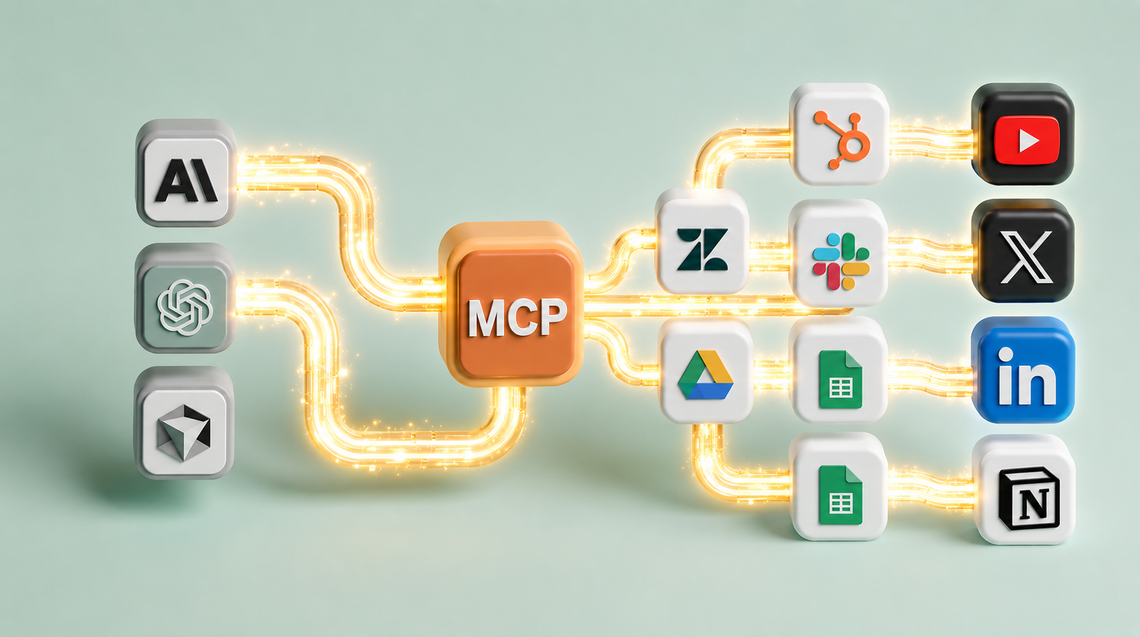
MCPs Are the Cheat Code for Founders. Here Are the 5 I Run Every Day.
Most founders use Claude like a chatbot. MCPs turn it into a system that runs parts of your business. Here are the 5 I use daily — and what they replace.