Your Competitors Are Hiring AI — Here’s the Stack You’re Missing
Your competitors aren’t using AI — they’re building teams with it.
Here’s the stack: 4 AI roles, 5 real workflows, and the system that runs a business 24/7.
The most dangerous thing about AI in 2026 isn't that it's replacing people. It's that most founders are still using it like a very fast search engine — while their competitors are building entire departments out of it.
⚡ The 2026 Inflection Point
40% of workflows will be run by AI by 2026. The companies already doing it? Seeing up to 610% revenue growth and cutting costs by 70%.
Meanwhile, most founders are still using AI like a search bar.
This isn’t a trend. It’s a takeover.
Agentic AI doesn’t wait for prompts. It takes a brief, executes the work, and reports back.
The shift is simple: Stop using AI. Start managing it.
AI Tool vs AI Agent — The Distinction That Changes Everything
🔧 AI Tool (Where Most Founders Are)
⚡ AI Agent (Where the Leverage Is)
How it works
You open Claude or ChatGPT. You type a prompt. You get a response. You copy it somewhere. You close the tab. You come back tomorrow and do it again.
You define a goal. The agent researches, decides, acts, checks its own output, connects to other tools, and delivers a finished result — without you intervening at each step.
The dynamic
You are the operating system. The AI is the calculator.
The AI is the operating system. You are the director.
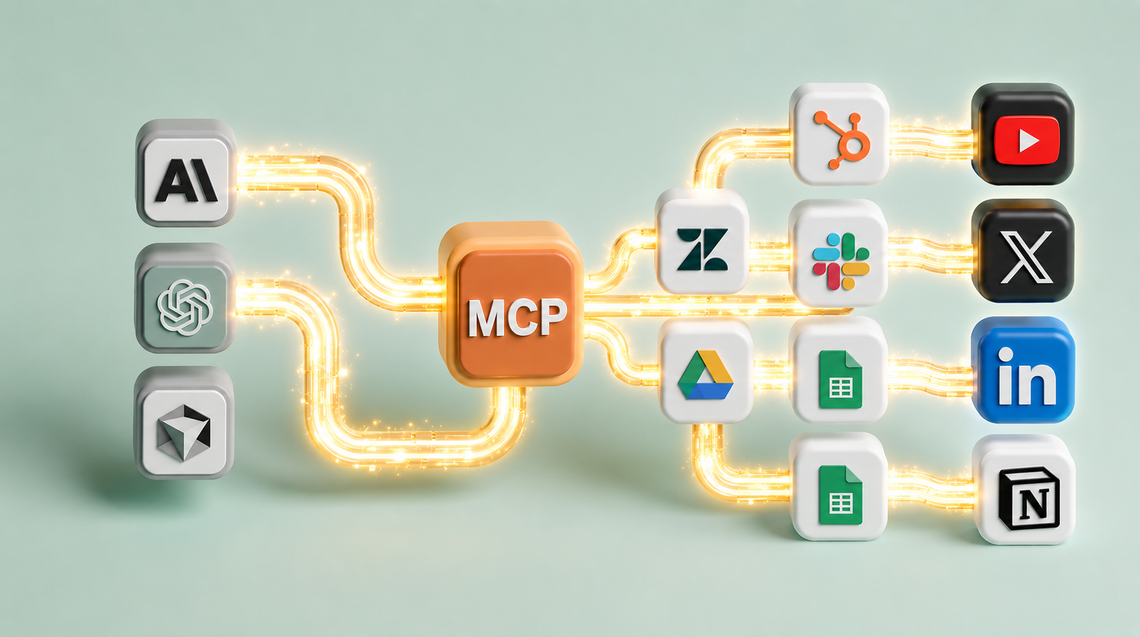
The practical difference is enormous. A tool multiplies the speed of one task. An agent multiplies the output of an entire function. And when you stack multiple agents together — each one handling a different role — you've built something that functions like a team without the headcount.
💡
Only 1 in 4 are doing this right - Everyone else? Still prompting.
The 4 AI Employees Founders Are Deploying Right Now
Role 1 — The Research Analyst
Brief: find what I need to know before I need to know it. This agent monitors industry developments, competitor activity, trending topics in your niche, and surfaces relevant information in a structured weekly report. Built with Claude + Zapier + a document output to Google Docs or your newsletter prep folder. Runs every Sunday. You read it Monday morning. You didn't spend a single minute searching.
Role 2 — The Content Producer
Brief: take one idea and turn it into a full week of content across every platform. Input a core insight or topic. The agent drafts the newsletter section, three Instagram captions, a LinkedIn post, a short-form script, and a hook list — each adapted to platform and audience. Built with Claude for long-form, ChatGPT for rapid variation, Zapier to route outputs to the right folder. One input. Ten outputs. One pass of human editing.
Role 3 — The Client Ops Manager
Brief: handle every touchpoint between enquiry and onboarding without me. This agent manages intake form responses, sends personalised follow-up emails via Kit, routes leads based on their answers, schedules discovery calls, and triggers the relevant onboarding sequence when a client signs. Built with Kit + Zapier + a simple intake form. You get notified when a call is booked. Everything before that happened automatically.
Role 4 — The Community Engagement Manager
Brief: keep the community active and new members engaged without manual effort. This agent posts weekly prompts and discussion starters in Circle, sends check-in messages to members who've gone quiet, tags members based on their activity level, and triggers a re-engagement sequence for members approaching churn. Built with Circle + Zapier + Kit sequences. The community stays alive. You stay focused on high-value work.
What This Means for Your Business Right Now
You don't need a technical background to build these. You need a clear brief, the right tools, and the patience to set the system up once. The founders who are doing this aren't software engineers. They're operators who understood that the question has changed.The old question was: how do I use AI to do this faster?The new question is: which of my business functions can I hand entirely to an agent?That shift in framing is where the leverage lives. Not in prompting better — in thinking about your business as a set of roles that can be delegated, and asking which of those roles a well-briefed AI system can now own.
3 Actions to Start This Week
Pick one repeatable function and write the brief for it.
Not a prompt — a brief. What does this function need to accomplish? What inputs does it receive? What does a good output look like? What does it connect to? Write it like you're hiring someone. That's exactly what you're doing.
Map the tools already in your stack that could power it.
You likely already have Claude, Zapier, Kit, and Circle. Most founders don't need new tools — they need to connect the ones they already have into an agent workflow. Start there.
Run one agent workflow manually first.
Before automating, walk through the steps yourself once. This surfaces every edge case, every decision point, every place the agent might get it wrong. It's the fastest way to write a reliable brief — and it shows you exactly what to automate vs what to keep human.
🤖 Prompt — Claude | Define Your First AI Agent Role
Build Your First AI Employee — Define the Role Before You AutomateI want to build my first AI agent for my business.My business:[Describe briefly]The function I want to systemise:[e.g. content production / client onboarding / research / community management]Create a complete AI agent brief for this function.Include:Agent Role TitleCore Objective (one clear sentence)Inputs (what data, prompts, or triggers it receives)Process (step-by-step actions it takes to complete the task)Outputs (what it produces and where it sends it)Tool Stack Integration (choose from: Claude, ChatGPT, Zapier, Kit, ManyChat, Circle, Canva, Google Docs)One Human Review Checkpoint (a critical decision point before final execution)Format the response as a clean, structured agent brief that can be:Handed to a developerOr implemented directly using Zapier workflowsKeep it practical, concise, and execution-focused. Avoid theory.
The £0 AI Stack Running My Entire Business Backend.
You're using one AI tool for everything and getting 60% of the capability. Here's the £0 stack — Claude + ChatGPT + Gemini routed correctly — that runs my entire backend.
#NFF · Automated Backend → Creative Frontend
The clean dividing line. The backend (automation · AI · systems) runs hands-off. The frontend (camera · voice · story · me) is 100% personal. When you draw the line clean, you get scale and soul at the same time.
members only
AI Integration
This Prompt Wrote 30 Days of Content in 4 Minutes. I'm Not Joking.
I built one Claude prompt that produced 30 days of social content in 4 minutes 23 seconds. The trick isn't the model — it's the 5-block prompt architecture. Here's the full build.
members only
AI Integration
The 15-Minute Morning AI Routine That Replaced My £3,000 Consultant
I used to pay £3,000/month for a strategic consultant. A 15-minute morning AI routine now does 80% of what they did — daily, not monthly. Here's the exact 3-phase system.
Founders and Systems tier
AI Integration
MCPs Are the Cheat Code for Founders. Here Are the 5 I Run Every Day.
Most founders use Claude like a chatbot. MCPs turn it into a system that runs parts of your business. Here are the 5 I use daily — and what they replace.
Content Systems
Stop Chasing Followers. Build This Revenue System Instead.
500 followers can outperform 50,000.
Here’s the revenue system that actually converts.