


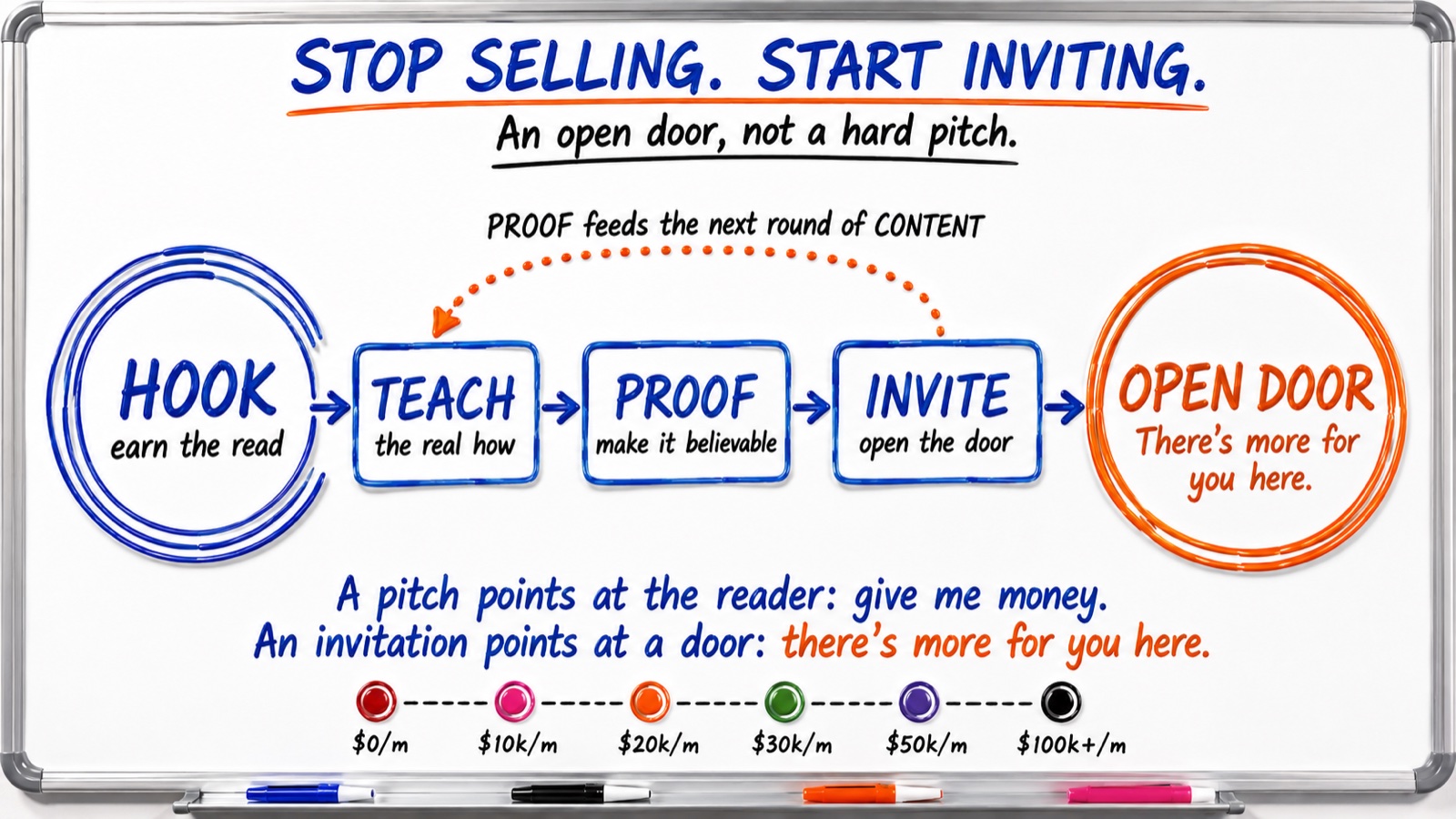
#NFF · Stop Selling. Start Inviting.
Your content is good — useful, generous, clear — and it still makes you £0. The thing it's missing isn't a harder pitch. It's an open door.
The clean dividing line. The backend (automation · AI · systems) runs hands-off. The frontend (camera · voice · story · me) is 100% personal. When you draw the line clean, you get scale and soul at the same time.
For a long time I had it inverted.
The backend of my business — the email automations, the tagging logic, the client onboarding, the delivery sequences — was all manual. I was the wiring. Every new subscriber got a personal welcome (sometimes). Every new client got me sending the welcome email + the intake form + the calendar link by hand. Every project status update was a Slack message I typed myself.
Meanwhile the frontend — the content, the camera, the voice — was where I was reaching for automation. Generic AI-drafted captions. Stock photography. Templated hooks that sounded like everyone else’s hooks. The bit that was supposed to be the most personal expression of the brand was the bit getting outsourced to generic tools.
Inverted. Scale on the wrong side. Soul on the wrong side. Everything felt expensive and nothing compounded.
The fix is a clean dividing line, and once you see it you can’t unsee it.
Every creator business has two distinct halves. They look like one thing from outside, but underneath they’re entirely separate operations.
The backend is the wiring. Email automations. CRM tags. Payment processing. Client onboarding. Lead capture. Welcome sequences. Re-engagement flows. Customer support. Project management. Calendar scheduling. Document delivery. Tagging architecture. All the connective tissue that turns a website visitor into a paying customer and a paying customer into a returning one.
The frontend is the soul. The newsletter you write Friday morning. The video you film standing in front of the camera. The DM conversation with a prospect at 11pm. The workshop you deliver live. The voice on the podcast. The story you tell on stage. The handwritten note in the welcome pack. All the work where the audience experiences you, not the brand.
The model is simple: automate the backend completely. Keep the frontend 100% personal.
Most creators do it backwards. They try to automate the frontend (AI captions, AI-generated thumbnails, AI replies to DMs) and leave the backend manual. The result is scale that feels soulless — because the soulful bits are getting outsourced to bots — and operations that feel expensive because the wiring eats hours that should never have been founder hours.
For every part of your business, run three questions:
If yes to any of the three → that’s frontend. Keep it personal. Block calendar time. Show up as yourself.
If no to all three → that’s backend. Automate it ruthlessly. Build the Skill, wire the Zapier, integrate the MCP. Remove yourself from the loop.
The mistake creators make is running the test loosely. “Well, it’s nicer if I do this myself…” That’s not the test. The test is whether the audience would feel a meaningful difference. If they wouldn’t, automate it.
Here’s where each side lives in my business — and where I’d argue every creator’s should:
The frontend list is short. The backend list is long. That’s the right ratio. The frontend is where I add value the audience can’t get anywhere else. The backend is the infrastructure that lets the frontend actually compound.
There’s a specific reason most founders run the model upside down. It’s not because they don’t know the right shape. It’s because the backend feels boring and the frontend feels productive.
Building a Kit automation feels invisible. There’s nothing to post about it. Nobody likes your “wired up a new tag-routing logic” tweet. The work is real but it doesn’t read as work.
Filming a video feels productive. There’s a thumbnail to share. There’s a post to make about the post. There’s content about the content. The work is visible.
So founders pour hours into the visible work and skip the invisible work. Six months later they have lots of frontend, no backend, and a business that depends entirely on founder presence — which is exactly what kills the compound.
The reverse is what works. Boring backend. Magnetic frontend. The boring backend is what lets the magnetic frontend scale.
Score Yes/No: Do you personally write every welcome email a new client receives? → Frontend doing backend work. Do you outsource your YouTube thumbnails / face / voice to a template? → Backend doing frontend work. Do you manually invoice clients? → Frontend doing backend work. Do you have AI writing captions in your voice without review? → Backend doing frontend work. Do you personally schedule discovery calls? → Frontend doing backend work. Are your DMs handled by a VA who doesn't sound like you? → Backend doing frontend work. Are you in every onboarding session for new members? → Frontend doing backend work. Scoring: 0–1 Yes → Line is mostly clean. Refine. 2–3 Yes → 1-2 leaks. Patch this month. 4+ Yes → Line is badly drawn. Full re-architecture needed. Rule of thumb: if the work requires you specifically to be in the room, it's frontend. If it doesn't, it's backend.
If your audit just revealed your backend is manual and your frontend is partially automated, here’s the sequence to flip it:
Week 1 — Inventory. List every recurring operation in your business. Apply the 3-question test to each. Sort into Frontend / Backend / Hybrid. The Hybrid bucket gets parked — you’ll resolve those in week 4.
Week 2 — Backend installation, round one. Pick the 3 backend items eating the most founder hours and automate them first. For most creators that’s: welcome sequence, client onboarding, inbox triage. Build the Kit automations + Zapier zaps + Claude Skills. Test. Ship.
Week 3 — Backend installation, round two. Pick the next 3. For most creators that’s: re-engagement, calendar qualifying, social scheduling. Install. Test. Ship.
Week 4 — Frontend re-personalisation. Audit every place you’d been using AI on the frontend — captions, hooks, replies — and pull yourself back in. The Skills produce drafts but you do the codifying pass. The voice has to be yours. The story has to be yours. The DMs that move toward a sale have to be yours.
By end of month: backend humming, frontend magnetic. The business stops feeling expensive. The audience stops feeling like they’re talking to a brand instead of a human.
The creators who scale past £30K/month without losing the personal connection that built them all run this model. Matt Gray runs it. Tom Young runs it. Taki Moore runs it. They’re not posting more than you. They’re not on camera more than you. They’ve drawn the line in a place where the backend compounds invisibly and the frontend stays 100% theirs.
The creators who scale past £30K/month and do lose the soul are the ones who got the model wrong. They automated the frontend in pursuit of leverage and lost the trust signal that built the audience. The numbers held briefly. The conversion rate dropped. Within 12 months the audience felt like they were following a brand, not a human — and they left.
The dividing line is the safeguard. Automate the backend. Multiply the frontend. Never cross the streams.
That’s build the backend as a positioning principle — not just operations. The backend is what lets you stay personal at scale. Without it, the frontend gets diluted because there aren’t enough founder hours to support it. With it, the frontend can be 100% you forever — because the founder hours stop being eaten by wiring work.
If your business currently runs both halves manually, you’re going to burn out. If it runs both halves automated, you’re going to lose the audience. The model that scales without breaking either side is the one above.
Three moves:
By month 3 the model is installed. By month 6 the compound shows in revenue. By month 12 you’ll wonder how you ever ran it inverted.
Automate the backend. Multiply the front end. That’s the only model that runs while you sleep — without losing the soul that made the business worth running in the first place.
— Quinton
📬 No-Fluff Friday — one sharp move every Friday morning Dubai.
Read the archive: newsletter.founders.systems
.






Member discussion