

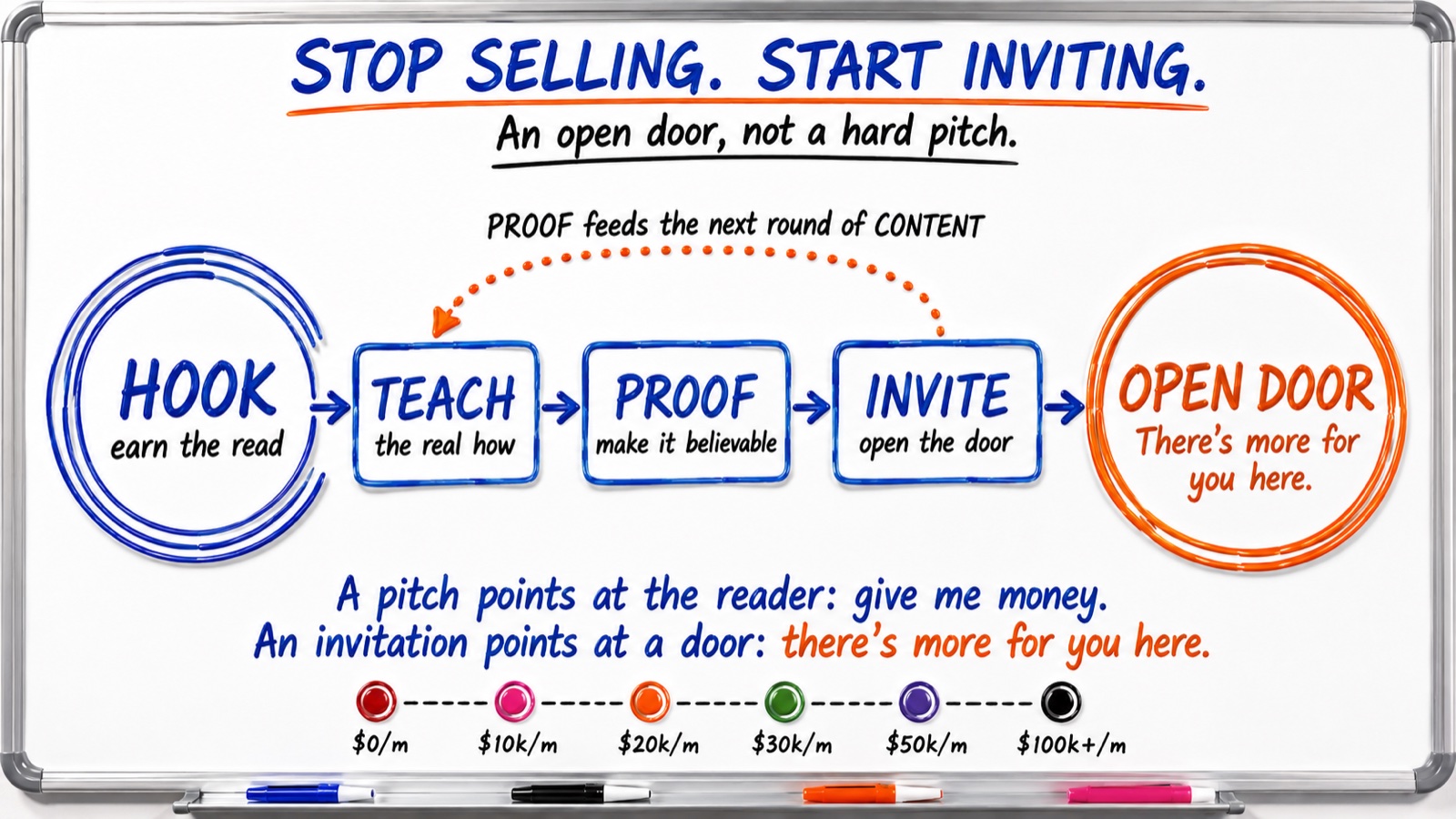
#NFF · Stop Selling. Start Inviting.
Your content is good — useful, generous, clear — and it still makes you £0. The thing it's missing isn't a harder pitch. It's an open door.
Hook. Stack. Payoff. Invite. That's it. That's the whole framework. The viral 1% nail all four and put them in the right order. The other 99% start in the middle, ramble for a paragraph, and forget the invite entirely.

A few Tuesday mornings back I did something that no creator enjoys: I ran a brutal audit on my own last 30 posts. IG carousels, LinkedIn singles, the NFF intros, a couple of YouTube hooks. Anything that had gone out under my name. Coffee in hand, ego firmly left at the door.
I had a hunch, and I didn't like it. Most of the pieces I'd quietly told myself were "fine" were actually built from one or two of four bricks I teach in my community — the bare minimum, dressed up to look finished. The pieces that genuinely moved the needle — the DMs, the apply-page traffic, the comments that turned into clients — had all four. Every time. No exceptions.
The audit result was a little humbling. Seventeen of the thirty were Hook plus Stack, followed by a sort of polite British drift into nothing — the content equivalent of starting a sentence with real conviction and then just sort of trailing off. Six had a Hook and a Payoff but no Stack to earn it. Three had a Stack and an Invite but no Hook to stop the scroll. Only four — out of thirty — had all four bricks in the right order.
Those four were 80% of the inbound that week.
That's not a coincidence. That's the whole game. If you're a creator, a coach, a solopreneur — anyone whose business runs on the back of a feed — this is the single highest-leverage thing I can hand you all year. Four bricks. Right order. Every time. It's not clever. It's just disciplined, and discipline is the bit everyone skips.
This is a framework I drill into my community until people can recite it in their sleep, then translated into the F&S vocabulary so it ports cleanly across surfaces. Every post — carousel, single, NFF intro, YouTube cold open, even a DM — is built from these four bricks. Once you see them, you can't unsee them.
That's the entire thing. Four bricks. Now let me pull each one apart properly, because this is exactly where most creators leak conversion without ever noticing the puddle.
The hook isn't there to be clever. It's there to make the thumb stop. That's the whole job. A good hook does one of three things: it contradicts what the audience expects, it names a number so specific it feels too concrete to be made up, or it describes a scene they recognise so vividly they think you've been reading their diary.
What kills hooks is hedging. "Here's a few thoughts on…" is not a hook. "Let me share something interesting…" is not a hook. "I've been thinking about…" is not a hook — it's a writer clearing their throat in public. The reader doesn't care that you're warming up. The reader is already gone.
Three hooks that consistently outperform for creators and solopreneurs in 2026:
One hook per piece. Front-loaded. Write a cheque with your hook, then spend the rest of the post cashing it.
This is the brick most creators skip, and they skip it because it's the only one that requires actual thinking. They hook beautifully, then leap straight to the conclusion — which lands as a bare opinion, because nothing in between earned the right to say it.
The stack is where you deposit the value. Three to four lines that build the case. A brilliant hook welded to a waffly stack is a great film trailer for a film that was never made.
The strong stacks I see all share three traits:
If your stack is doing its job, the payoff arrives feeling earned. If your stack is thin, the payoff arrives feeling preachy. That hollow "yeah, alright mate" feeling? That's a missing stack.
The payoff is the takeaway. The one sentence they'd screenshot. The line they'd quote back at you in a DM. The reason they'll still remember the post 48 hours later instead of it dissolving into the great grey soup of the feed.
Most creators bury the payoff under three apologies. "It's probably different for everyone, but I've kind of found that maybe sometimes…" — that's not a payoff, that's a payoff in a witness protection programme. The strong move is to land it like a knife. One sentence. No hedge. Conviction travels; caveats don't.
A payoff is doing its job when it answers the question the hook quietly opened. Hook says "you don't actually want a bigger audience" — payoff says "you want a backend that monetises the audience you've already got." Open the loop. Close the loop. No scenic detour through your feelings on the way.
The invite is the one everyone forgets. It's also the one that pays the mortgage. This is where roughly 80% of creators simply drop the post on the floor — they end with "thoughts?" or "let me know what you think" or, my personal favourite, absolutely nothing at all. A perfectly good piece, no door at the end of the corridor.
The invite is not "engage with me." The invite is a named, specific, low-friction next move. The lowest-friction one I know is the comment-trigger model: a single word the reader types in the comments, which ManyChat catches and turns into a DM carrying the next step.
Three invite formats that work for creators and coaches right now:
The invite is the entire reason the post exists. It is not optional. Every piece gets one. People need to see the door more than once before they walk through it.
Takes about 90 seconds. Catches roughly 90% of the conversion leak before it reaches a human.
Fail any one of the five and the piece doesn't ship. No exceptions. Most creators don't have a content problem — they have a brick-count problem. Add the missing bricks. Reorder. Ship.
The four bricks aren't a carousel framework or a LinkedIn framework. They're the deep grammar of any piece of content that moves the business.
Same four bricks. Same order. Different surface. The framework holds because it's grounded in how human attention actually works — and attention doesn't get updated every six weeks like the algorithm does.
I've turned the 90-second check into a one-page card you can stick above your monitor. Carousel-friendly, NFF-friendly, YouTube-friendly. It's the exact card I run every Saturday before the week's content ships.
DM me "BRICKS" on LinkedIn or Instagram and I'll send it over — no opt-in wall · keep it or bin it.
Four bricks. Right order. Every piece.
Quinton · Founders & Systems
Helping creators ship content that actually converts.
.







Member discussion