


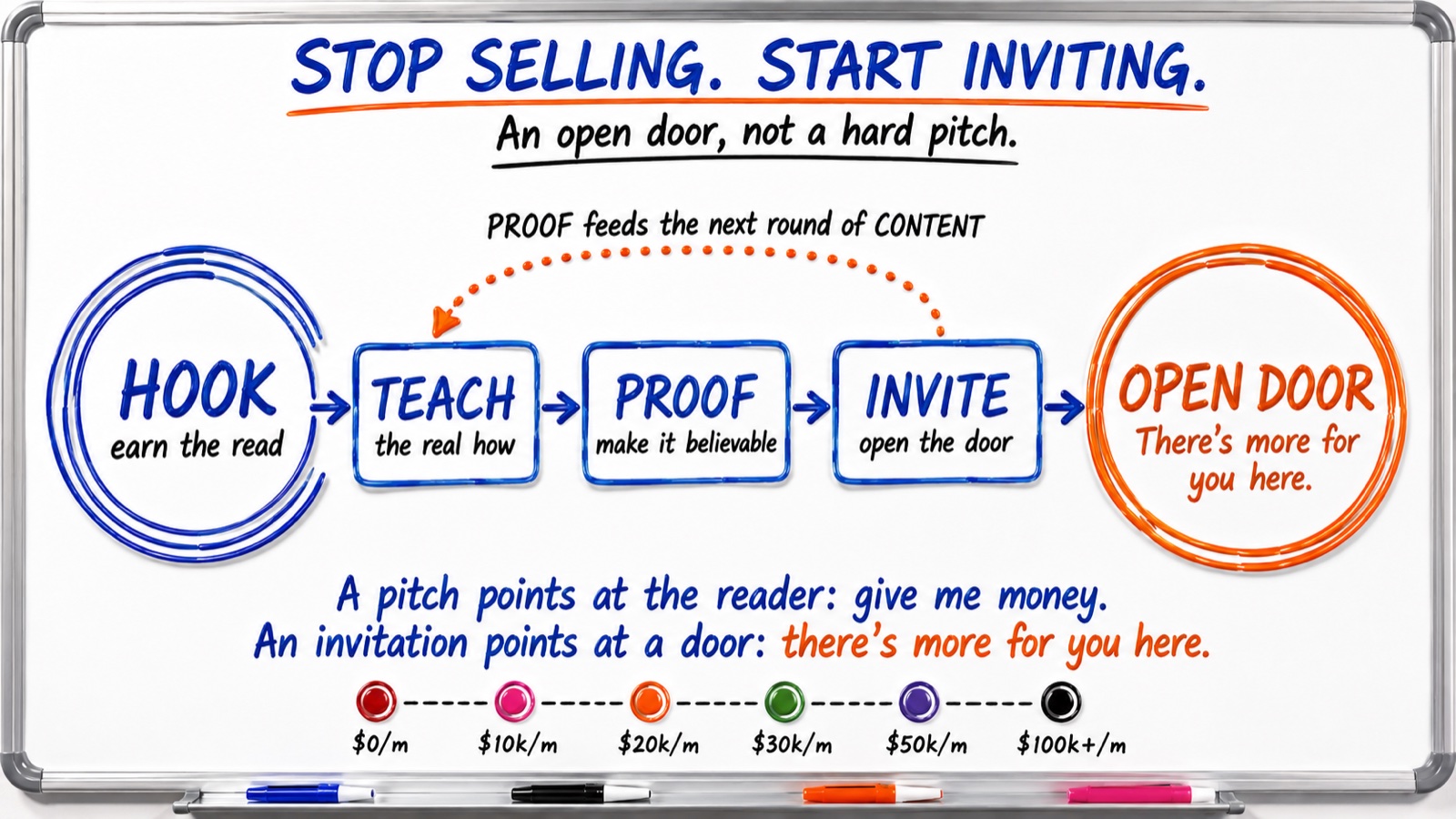
#NFF · Stop Selling. Start Inviting.
Your content is good — useful, generous, clear — and it still makes you £0. The thing it's missing isn't a harder pitch. It's an open door.
If you're sat at a blank doc on Tuesday morning trying to invent something to say, you've already lost the week. The fix isn't another prompt. It's a different posture. Capture, don't create.

I want to start with a confession. For about two years I treated content the way most people treat the gym in January — a separate thing I had to drag myself to, full of guilt, usually skipped. Then I changed one assumption and everything got quieter. Not louder. Quieter. Less effort in, more out. Here's the assumption I changed.
I stopped trying to make content. I started trying to capture it. The best creators I know don't sit down to produce. They're just having the conversations they'd be having anyway — calls, Q&As, workshops, the odd voice memo in the car — and there's a camera or a transcript running while they do it.
The content is a byproduct of the work. It's not a separate workstream. It's not a separate Tuesday morning. It's what falls out of the job when you remember to point a camera at it.
This is the single biggest unlock for creators in 2026, and almost nobody I work with is running it properly. They're still treating content as a thing they sit down to make. Cold start. Blank doc. The flashing cursor. "What should I post today?" And every single Tuesday morning the cost of that blank doc quietly compounds — roughly 90 minutes of cognitive warm-up before the first usable line even lands on the page. We've all done it. Some of us call it "thinking." It's mostly just dread with good posture.
Capture posture flips the whole thing. The content was already happening in the room. You just weren't recording it.
Let's run the maths properly, because this is the bit everyone skips — usually because the answer is mildly horrifying. Say you ship three or four pieces of content a week. Each one starts from blank. Each one takes around 90 minutes of think-write-edit-polish before it goes live.
That's 4.5 to 6 hours a week. Twenty-something hours a month. Two hundred and fifty hours a year — the equivalent of six and a half full working weeks — spent thinking about what to say before you've even picked up the camera or opened Canva. Six and a half weeks. Gone.
And here's the worse bit, the part that actually stings. Most of those 250 hours produce content you don't even like. The pieces feel forced. The hook is tight because you sweated over it, but the substance underneath is thin — because by the time you got to the substance you'd run out of road.
This is phantom load at its most expensive. Effort going in. Output that doesn't move the needle. The work feels real because the hours show up on the timesheet — but the bank account doesn't notice, and neither does the audience. You were busy. You weren't productive. There's a difference, and content is where most creators confuse the two.
The shift isn't "record more videos." It's a sequencing change — move content from "a thing I sit down to invent" to "a thing I quietly collect while I work."
None of them need a "content session." The cost of capture is roughly zero, because you were already doing the thing — you just weren't pressing record.
I call this the self-licking ice cream cone, and once you see the loop you genuinely can't unsee it:
The more clients you serve, the more raw material you capture. The more material you capture, the more you can publish. The more you publish, the more clients walk in. The work and the content stop being two jobs. They become one. That's the whole trick.
This is what people actually mean — or should mean — when they say "build a content engine." Not "post more." Build the loop where delivery and capture are the same single move. One activity, two outputs. That's leverage. Everything else is just hustle with better lighting.
The publish layer still needs a batched window — but that window is now an editing window, not a creation one. You're not inventing. You're choosing.
That's the week done — 90 minutes rather than 6 hours, because you weren't creating from blank. You were curating what already happened. Editing is fast. Inventing is slow. This is compound mode for content.
Every batched system eventually drifts back into chaos if you let it. It's the default state of all systems and most kitchens. The rule that prevents the drift here is brutally, almost crazyly simple:
The reason most creators fail at batching isn't the batching. It's that they never enforce the capture half. They sit down on Saturday with three voice memos and a vague sense of optimism, and they try to invent material on the spot. The block stretches to three hours. They burn out by week four. Then they declare batching "a fad that doesn't work for them" and crawl back to the Tuesday-morning blank doc like it's an old friend. It is not your friend.
The block is fast because the captures are rich. The captures are rich because the loop is wired into your delivery. And the whole system runs on one piece of discipline: capturing every week. Even the boring weeks. Even the holiday weeks. Something happened. You just didn't write it down.
Three notes a day. Voice memos in the car. Two lines in Notion after every call. Do that, and by Saturday morning the signal is there waiting for you. The Skill mines it. The week ships. You go and have your weekend back like a functioning adult.
Don't try to wire all three mechanisms at once on Monday morning. Pick one. The lowest-friction one for most creators is the conversation capture — because the conversations were already happening whether you recorded them or not.
That's the entire onboarding to capture posture. One mechanism. One Friday pass. One Saturday block. Give it three weeks and you'll feel it shift.
"But my coaching calls are confidential." "My workshops are paid, the attendees won't want to be filmed." All fair — and none of them kill the model. They change what gets captured, not whether you capture at all. Separate the specifics of a conversation from the pattern underneath it. The client's name, the company, the exact numbers — none of that ships. Ever. The pattern — the question they asked, the framework you walked them through — that absolutely ships.
With those three rules in place, capture posture is clean, sustainable, and frankly more honest than half the "case studies" floating around out there.
I've put the self-licking ice cream cone diagram, the three capture mechanisms, and the 90-minute Saturday block onto a single page you can pin above your desk.
DM me "CAPTURE" on LinkedIn or Instagram and I'll send it over — no opt-in wall · keep or bin.
Capture, don't create. The content was already happening — you just weren't recording it.
Quinton · Founders & Systems
Helping creators, solopreneurs and coaches build a business that runs without them.
.







Member discussion